
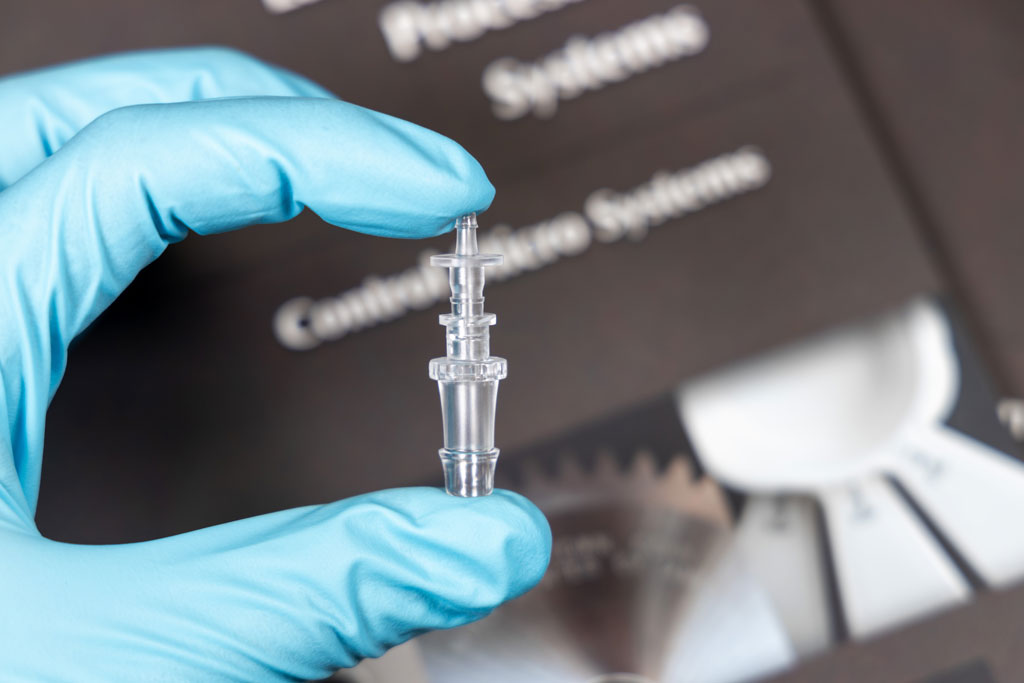
Drug delivery devices are often made from transparent polymers so patients and clinicians can verify doses, monitor fluid flow, and inspect components visually. For the manufacturer, joining clear plastics without clouding, particulates, or toxic adhesives has been a challenge, while lasers typically used in high-precision welding pass right through transparent materials without impact.
2 μm (micron) laser welding offers another approach. At this wavelength, select transparent polymers can absorb laser energy directly, allowing heat to be generated at the joint without requiring an added laser-absorbing pigment. CMS Laser develops custom laser processing systems to help medical device manufacturers evaluate and implement clear-on-clear plastic welding for their unique applications.
How 2μm Laser Welding Joins Transparent Plastics Without Additives
Insulin pens, diagnostic cartridges, infusion bags, and other single-use clinical plastics must remain completely free of chemical and particle contamination. Standard joining techniques come with certain risks: adhesives can trigger outgassing and ultrasonic welding and other mechanical joining processes require careful control of tooling, joint design, and process conditions. Through-transmission laser welding (~ 1 μm) typically used for plastics requires dark pigment additives for absorption – equally non-viable for medical use.
Operating near the 2 μm wavelength changes the absorption profile: optically clear polymers absorb enough of the laser energy without any additives or mechanical contact. The localized heating from this absorption produces a clean melt zone that solidifies quickly, leaving hermetic seals with reduced biocompatibility concerns. However, suitability depends on the specific polymer grade, optical properties, material formulation, component geometry, and welding parameters.
Learn more about laser welding technology and plastic joining applications.
Weld Precision and Beam Shaping for Clear Plastics
As a non-contact, light-based thermal process, laser welding delivers the extreme precision needed in drug delivery device assembly. A 2 μm laser is no different from traditional laser processing when it comes to tight tolerances: it delivers finely detailed weld seams and repeatability of just a few microns. Because thermal input is strictly localized, the process minimizes melt squeeze-out, preventing flash from intruding into adjacent fluid pathways. The resulting continuous seam delivers a hermetic seal capable of meeting strict burst pressure standards while preserving total optical clarity for downstream dose verification.
To optimize thermal transfer in clear plastics, the system utilizes a top-hat beam profile rather than a standard Gaussian beam. By distributing energy uniformly across the beam’s cross-section, top-hat profiles promote consistent melting through the plastic joint while preventing localized overheating or material damage. Beam focusing is tailored directly to part geometry and weld requirements: using an f-theta lens, which maintains a uniform spot size across the scan field, or a smaller single-element lens when a tighter focus is required for specific part geometries.
A successful transparent plastic weld depends on more than laser wavelength alone, however. CMS Laser works with device manufacturers to evaluate samples, establish suitable process parameters, and identify an appropriate system configuration.
Designing a Laser Welding System for Drug Delivery Devices
To bring 2 μm beam delivery into cleanroom manufacturing, CMS Laser integrates precision optics into a dedicated industrial workstation specific to each application.
Fixtures and Workholdings
A heavy-duty welded steel base provides the machine foundation, while an enclosure with appropriate laser-safe windows helps contain the laser processing area. Inside, a programmable multi-axis gantry drives the laser head for 2D or 3D contouring. For circumferential seam welding, a removable rotary chuck rotates the workpiece. Parts can be held in application-specific fixtures mounted on a precision-machined tooling plate. Fixture design and flatness requirements are established according to the component geometry and positioning tolerances needed for the weld. Other part handling components are integrated as needed.
Vision Alignment and Weld Inspection
Part alignment and quality control are streamlined through configurable vision systems. In manual workflows, an integrated CCTV camera with crosshair overlays allows operators to visually align parts via XY jogging before initiating automated processing. For tighter micro-welding tolerances, the system can be equipped with our Through-the-Optics Vision (TTOV) to align a camera coaxially with the laser beam. When post-processing inspection is part of the operation, we integrate AI-powered cameras to automatically detect and flag weld defects in real time.
Laser System Controls, Fume Extraction, and Safety
To maintain high weld quality, built-in connection ports enable precise shield gas delivery, while a fume extraction system evacuates airborne particulates to protect the laser beam delivery optics and extend hardware life. System setup and daily operation are managed through an arm-mounted display and keyboard station with status indicators and an immediate E-stop switch.
CMS Laser units meet OSHA, FDA/CDRH Class I, and NFPA 79 electrical safety standards, with regional compliance certifications (CE, CSA, UL) available based on deployment requirements.
Custom Solutions With 2 μm Laser Welding
Drug delivery device manufacturers need joining processes that fit their materials, component designs, quality requirements, and production targets. For transparent plastic assemblies, 2 μm laser welding can provide an alternative to joining methods that depend on added laser absorbers or adhesives.
By combining application-specific laser parameters, suitable beam profiles, precision focusing optics, and purpose-designed workholding, CMS Laser helps manufacturers evaluate and develop repeatable clear-on-clear welding processes.
Every application presents different challenges. A small diagnostic cartridge may require precise alignment around narrow weld features, while a fluid-handling component may place greater emphasis on leak performance, joint continuity, and optical inspection. Production volume, cycle time, automation, and inspection requirements also influence the appropriate system design.
CMS Laser works directly with device engineers to evaluate representative parts, optimize process parameters, and develop systems for research and development, process development, or production. Explore our system design process and read customer testimonials in this blog.
Ready to evaluate additive-free laser welding for your drug delivery device? Contact us today.



0 comments
Comments for this post are closed.